Buy locaflat.eu ?
We are moving the project
locaflat.eu .
Are you interested in purchasing the domain
locaflat.eu ?
domain@kv-gmbh.de · 0541-91531010
Buy locaflat.eu ?
When do you use il faut and il ne faut pas?
"Il faut" is used to express what is necessary or required, while "il ne faut pas" is used to express what is not allowed or should be avoided. For example, you would use "il faut" to say "il faut étudier pour réussir" (it is necessary to study to succeed), and "il ne faut pas" to say "il ne faut pas fumer dans ce lieu" (smoking is not allowed in this place). These expressions are used to give advice, make recommendations, or set rules. **
What is the difference between il faut que and il faut?
"Il faut" is used to express a general necessity or obligation, while "il faut que" is used to introduce a specific action or event that is necessary or required. For example, "il faut manger" means "it is necessary to eat" in a general sense, while "il faut que tu manges" means "you need to eat" in a specific sense. "Il faut" is used to make a general statement about what is necessary, while "il faut que" is used to specify what needs to be done. **

Similar search terms for Vermentino-Il-Bianco-Il
Top-Angebote
Products related to Vermentino-Il-Bianco-Il:
-
Bianco 'Il Padrone delle Vigne' Tabarrini 2025alcoholic fermentation takes place in steel thanks to the action of indigenous yeasts. It ages for a few months in steel before being bottled. The “Padrone delle Vigne” White from Tabarrini presents itself in the glass with a straw yellow color with golden and bright reflections. The aromas recall ripe yellow-fleshed fruits such as melon, plum, and apple, but also notes of hawthorn and citrus on the finish; on the palate, the structure is full-bodied and smooth, with good sapidity and freshness that invite you to drink glass after glass. It pairs well with first courses seasoned with shellfish and mollusks; sushi and sashimi, and dishes based on seasonal vegetables; excellent also with fresh cheeses. A product to be kept in your personal cellar for every occasion: outdoor gatherings with friends or home lunches focused on lightness, to enjoy a wine that encapsulates the fruits and values of the Umbrian land and to savor tradition in the glass.alcoholic fermentation in steel thanks to the action of indigenous yeasts. It matures for a few months in steel before being bottled. The "Padrone delle Vigne" Bianco di Tabarrini presents itself in the glass with a straw yellow color with golden and brilliant reflections. The aromas recall ripe yellow-fleshed fruits such as melon, plum, and apple, but also notes of hawthorn and citrus on the finish; on the palate, the structure is full-bodied and soft, with good sapidity and freshness that invite sip after sip. It is recommended to pair with first courses seasoned with shellfish and mollusks; sushi and sashimi, and dishes based on seasonal vegetables; also excellent with fresh cheeses. A product to be kept in your personal cellar for every occasion: outdoor gatherings with friends or home lunches characterized by lightness, to enjoy a wine that encapsulates the fruits and values of the Umbrian land and to savor tradition in the glass.14,00 £*Shipping: 48,00 £Secure redirect to the provider
-
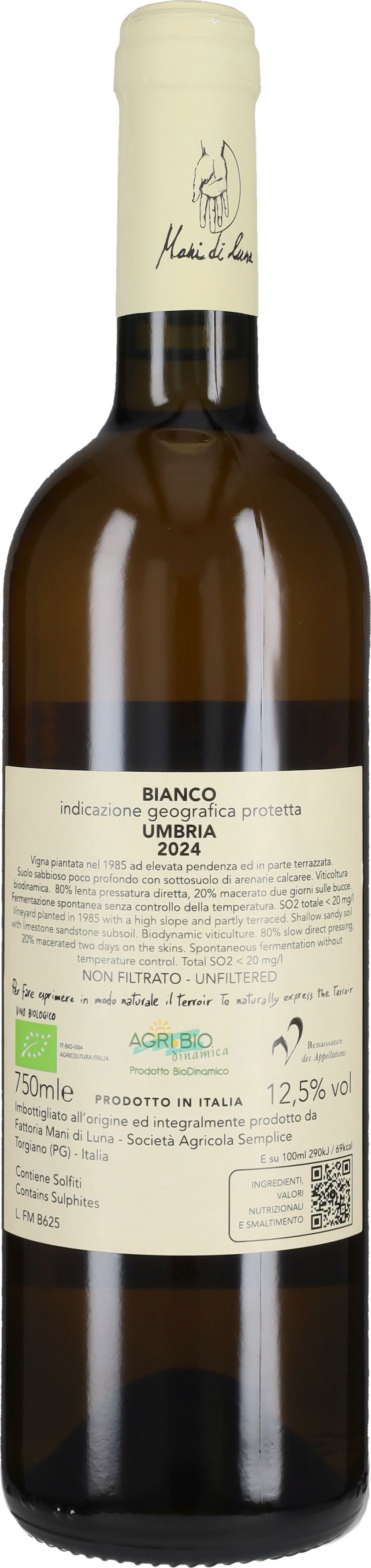
Bianco 'Il Baratto' Fattoria Mani di Luna 2024Fattoria Mani di Luna presenta ‘Il Baratto’, un vino bianco artigianale che deriva da un assemblaggio di vitigni autoctoni e che, come afferma la stessa cantina, esprime un carattere territoriale più che varietale. La valorizzazione del terroir passa attraverso una filosofia produttiva sinceramente naturale, che abbraccia l’agricoltura biologica e quella biodinamica. Il nome della bottiglia si riferisce all’omonimo vigneto di 45 anni, ripido e in parte terrazzato, da cui provengono le uve.‘Il Baratto’ della cantina Fattoria Mani di Luna viene elaborato da un assemblaggio di Trebbiano Toscano, localmente chiamato Procanico, due tipi di Malvasia, Grechetto e anche RIesling. Il vigneto di origine, impiantato nel 1975, prende il nome di “Vigna Baratto”, ed è situato a 200-300 metri di altitudine su terreni ripidi e in parte terrazzati, composti da sabbie, argille e arenarie da antichi sedimenti marini e lacustri. La raccolta si verifica a mano e, successivamente, i grappoli sono pressati interi in un torchio verticale. La lenta fermentazione alcolica ha luogo spontaneamente in acciaio per 2-3 settimane, cui seguono 7 mesi di maturazione sulle fecce fini sempre in vasche d’acciaio, con periodici batonnage. L’imbottigliamento avviene in fase di luna calante, senza alcuna chiarifica o filtrazione.Alla vista, il bianco umbro ‘Il Baratto’ Fattoria Mani di Luna mostra una colorazione giallo paglierino tenue. Lo spettro olfattivo è delicato e fruttato, definito da sentori di camomilla, gelsomino, mele, fiori di campo e macchia mediterranea, associati a leggere nuance minerali e di idrocarburi. Sorso fresco, armonioso e beverino, di dissetante leggiadria. Un’interpretazione originale che ben si presta ad accompagnare stuzzichini e antipasti vari dal sapore delicato.19,00 £*Shipping: 48,00 £Secure redirect to the provider
-
Il Roccafiore' 2021"Il Roccafiore is the house red that bears the same name as the Umbrian winery that produces it, located in the green hills surrounding the town of Todi. Born from pure Sangiovese grapes, cultivated according to the principles of organic farming, it stands out for its inherent freshness and for the decided drinkability. A glass capable not only of masterfully interpreting this variety in Umbrian land but also of convincing the most diverse palates, thanks to the undisputed versatility offered at the table. This Sangiovese "Il Roccafiore" comes to life from grapes grown in vineyards located in Todi, at 350 meters above sea level on clay, limestone, and clay soils that give natural zest to the final sip. While in the vineyard it has always been organic farming that takes the lead, in the winery, they also rely on the most respectful winemaking practices possible for the fruit. Fermentation is spontaneous, initiated only with the use of naturally occurring yeasts on the skins and takes place in temperature-controlled thermoregulated stainless steel tanks with skin maceration for about twenty days. "Il Roccafiore" from the Roccafiore winery convinces both the nose and the palate with the harmony of aromas that unfold in fruity, spicy, and elegant tones. Thanks to an aging of about 24 months in 50-hectoliter Slavonian oak barrels, it is characterized by a typical underbrush bouquet, with plum, blackberries, and sour cherry jam in the foreground, enhanced by hints of licorice, oriental spices, and light tobacco. On the palate, it is full, rich, and enveloping, with a silky and firm tannin that finishes on a pleasant fruity note and a savory freshness that reiterates its easy drinkability. A glass with great cleanliness and character, capable of offering a vivid expression of Umbrian territoriality.14,00 £*Shipping: 48,00 £Secure redirect to the provider


-
Why is it souhaite-t-il and not souhaite-s-il?
In French, the pronoun "il" (he) is combined with the verb "souhaiter" (to wish) to form the phrase "souhaite-t-il" because of the rule of verb inversion in interrogative sentences. When forming a question in French, the subject pronoun and the verb are inverted, so "souhaite-t-il" follows this rule. The "t" is added to create a liaison between the verb and the pronoun, making the pronunciation smoother. **
-
What comes after il faudrait in French?
In French, "il faudrait" is followed by the infinitive form of a verb. This construction is used to express a suggestion or a polite request. For example, "il faudrait partir tôt" means "it would be necessary to leave early." **
-
How does "il faut" work in French?
"Il faut" is a common expression in French that is used to convey the idea of necessity or obligation. It is followed by an infinitive verb and is used to express what needs to be done or what is necessary in a given situation. For example, "Il faut manger" means "It is necessary to eat." This expression is used to give advice, make suggestions, or express general truths. **
-
What is an El, Sl, and Il?
An El, Sl, and Il are all suffixes used in the English language to form adjectives. "El" is used to form adjectives that mean "pertaining to" or "characterized by," such as in the word "musical." "Sl" is used to form adjectives that mean "tending to" or "inclined to," such as in the word "careful." "Il" is used to form adjectives that mean "having the nature of" or "capable of," such as in the word "flexible." These suffixes help to create new adjectives by modifying the meaning of the base word. **

What do the abbreviations el and il mean?
The abbreviation "el" typically stands for "elevated" and is commonly used in the context of transportation systems, such as an "el train" which refers to an elevated railway. On the other hand, "il" is often used as an abbreviation for "Illinois," which is a state in the United States. It can also be used as an abbreviation for "in-line" in various contexts, such as in sports or technology. **
What is the past tense of il faut?
The past tense of "il faut" is "il a fallu." This is the third person singular form of the verb "falloir" in the past tense. It is used to indicate that something was necessary or required in the past. For example, "Il a fallu partir tôt ce matin" means "It was necessary to leave early this morning." **
Top-Angebote
Products related to Vermentino-Il-Bianco-Il:
-
Vermentino 'Il Bianco' Il Torchio 2025The Bianco from the Il Torchio winery is a pure Vermentino produced in the Colli di Luni area, in the province of La Spezia. A wine immediate, fresh, and sunny, made with a brief maceration on the skins, which gives it a good structure and aromatic complexity. It represents a typically territorial expression of this interesting white grape variety, which loves warm, dry, and windy climates. Not surprisingly, Vermentino is widespread, not only in the eastern Liguria but also in Sardinia, Corsica, and southern France under the name Rolle. The Il Torchio winery produces its Bianco with pure Vermentino grapes, which come from the company estate: 12 hectares of property collected in a single plot beautifully exposed to the southeast. The grapes are vinified in steel with the sole use of indigenous yeasts and a light maceration on the skins, on half of the mass, lasting one or two days. The wine then ages on the fine lees in steel for at least 6 months, in order to achieve a good richness and aromatic complexity. It is bottled without proceedingof clarification or filtration. The Bianco Il Torchio well represents the elegant and sunny characteristics of the Ligurian Vermentino from the Colli di Luni area. It is the quintessential white of the territory, which pairs very well with dishes from Ligurian seafood cuisine. It has a very bright and luminous straw-yellow color. The bouquet expresses delicate notes of white flowers, aromas of yellow fruit, hints of Mediterranean scrub herbs, iodine and marine nuances. On the palate, it has a good structure, with a juicy and refreshing sip, mature aromas, and a beautiful savory vein. The finish is pleasantly balsamic.18,00 £*Shipping: 48,00 £Secure redirect to the provider
-
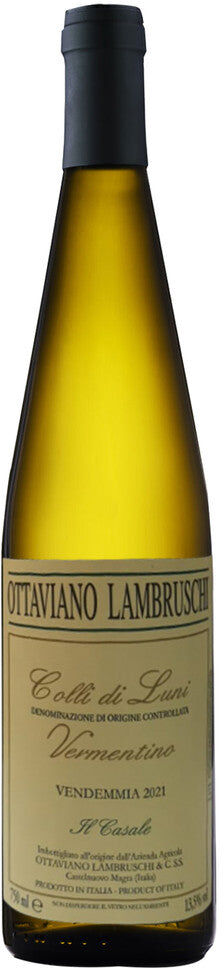
Lambruschi Ottaviano Vermentino 'Il Casale' Ottaviano Lambruschi 2023Il Vermentino di Ottaviano Lambruschi è un bianco fresco e immediato, dal profilo piacevolmente marino, che ben esprime il potenziale della zona dei Colli di Luni per la produzione di questa varietà. La piccola area collinare, che si trova nell’entroterra tra La Spezia e Massa Carrara, proprio al confine tra la Liguria e la Toscana, è particolarmente vocata per la coltivazione delle uve a bacca bianca, grazie alla splendida posizione geografica posta tra l’Appennino e il mare. Il clima mediterraneo, sempre ventilato e mitigato dalle brezze del vicino mar Tirreno, crea l’habitat perfetto per un vitigno che ama la vicinanza del mare come il Vermentino, non a caso presente anche in Sardegna e sul litorale Toscano. Il Vermentino Lambruschi è il bianco più famoso della cantina, quello che ha contribuito a farlo conoscere come uno dei produttori più interessanti della zona dei Colli di Luni e tra i maggiori interpreti in assoluto di questa varietà a bacca bianca, presente da secoli sulle coste del mar Mediterraneo. Le vigne sono coltivate nella tenuta di Castelnuovo Magra, in provincia di La Spezia, a un’altitudine di circa 200 metri sul livello del mare. Dopo la vendemmia, che solitamente si svolge a fine settembre, le uve vengono pressate in modo soffice. Il mosto fiore viene fatto fermentare in vasche d’acciaio alla temperatura controllata di 20/22 °C e il vino si affina, sempre in acciaio, per circa 6 mesi a una temperatura di 18 °C prima d’essere imbottigliato. Ottaviano Lambruschi Vermentino è un bianco dal volto tradizionale, che esprime perfettamente le migliori caratteristiche del vitigno e del territorio dei Colli di Luni. Un vino che conquista per la schiettezza espressiva e l’eleganza marina e iodata del suo profilo. Nel calice ha un colore giallo paglierino. Al naso esprime aromi di erbe aromatiche della macchia mediterranea, aromi di agrumi e di frutta gialla matura. Il sorso è fresco e sapido, piacevolmente succoso, con bella freschezza finale. Un bianco perfetto da abbinare a un menù di mare.16,00 £*Shipping: 48,00 £Secure redirect to the provider
-
Bianco 'Il Padrone delle Vigne' Tabarrini 2025alcoholic fermentation takes place in steel thanks to the action of indigenous yeasts. It ages for a few months in steel before being bottled. The “Padrone delle Vigne” White from Tabarrini presents itself in the glass with a straw yellow color with golden and bright reflections. The aromas recall ripe yellow-fleshed fruits such as melon, plum, and apple, but also notes of hawthorn and citrus on the finish; on the palate, the structure is full-bodied and smooth, with good sapidity and freshness that invite you to drink glass after glass. It pairs well with first courses seasoned with shellfish and mollusks; sushi and sashimi, and dishes based on seasonal vegetables; excellent also with fresh cheeses. A product to be kept in your personal cellar for every occasion: outdoor gatherings with friends or home lunches focused on lightness, to enjoy a wine that encapsulates the fruits and values of the Umbrian land and to savor tradition in the glass.alcoholic fermentation in steel thanks to the action of indigenous yeasts. It matures for a few months in steel before being bottled. The "Padrone delle Vigne" Bianco di Tabarrini presents itself in the glass with a straw yellow color with golden and brilliant reflections. The aromas recall ripe yellow-fleshed fruits such as melon, plum, and apple, but also notes of hawthorn and citrus on the finish; on the palate, the structure is full-bodied and soft, with good sapidity and freshness that invite sip after sip. It is recommended to pair with first courses seasoned with shellfish and mollusks; sushi and sashimi, and dishes based on seasonal vegetables; also excellent with fresh cheeses. A product to be kept in your personal cellar for every occasion: outdoor gatherings with friends or home lunches characterized by lightness, to enjoy a wine that encapsulates the fruits and values of the Umbrian land and to savor tradition in the glass.14,00 £*Shipping: 48,00 £Secure redirect to the provider
-
When do you use il faut and il ne faut pas?
"Il faut" is used to express what is necessary or required, while "il ne faut pas" is used to express what is not allowed or should be avoided. For example, you would use "il faut" to say "il faut étudier pour réussir" (it is necessary to study to succeed), and "il ne faut pas" to say "il ne faut pas fumer dans ce lieu" (smoking is not allowed in this place). These expressions are used to give advice, make recommendations, or set rules. **
-
What is the difference between il faut que and il faut?
"Il faut" is used to express a general necessity or obligation, while "il faut que" is used to introduce a specific action or event that is necessary or required. For example, "il faut manger" means "it is necessary to eat" in a general sense, while "il faut que tu manges" means "you need to eat" in a specific sense. "Il faut" is used to make a general statement about what is necessary, while "il faut que" is used to specify what needs to be done. **
-
Why is it souhaite-t-il and not souhaite-s-il?
In French, the pronoun "il" (he) is combined with the verb "souhaiter" (to wish) to form the phrase "souhaite-t-il" because of the rule of verb inversion in interrogative sentences. When forming a question in French, the subject pronoun and the verb are inverted, so "souhaite-t-il" follows this rule. The "t" is added to create a liaison between the verb and the pronoun, making the pronunciation smoother. **
-
What comes after il faudrait in French?
In French, "il faudrait" is followed by the infinitive form of a verb. This construction is used to express a suggestion or a polite request. For example, "il faudrait partir tôt" means "it would be necessary to leave early." **
Similar search terms for Vermentino-Il-Bianco-Il
-
Bianco 'Il Baratto' Fattoria Mani di Luna 2024Fattoria Mani di Luna presenta ‘Il Baratto’, un vino bianco artigianale che deriva da un assemblaggio di vitigni autoctoni e che, come afferma la stessa cantina, esprime un carattere territoriale più che varietale. La valorizzazione del terroir passa attraverso una filosofia produttiva sinceramente naturale, che abbraccia l’agricoltura biologica e quella biodinamica. Il nome della bottiglia si riferisce all’omonimo vigneto di 45 anni, ripido e in parte terrazzato, da cui provengono le uve.‘Il Baratto’ della cantina Fattoria Mani di Luna viene elaborato da un assemblaggio di Trebbiano Toscano, localmente chiamato Procanico, due tipi di Malvasia, Grechetto e anche RIesling. Il vigneto di origine, impiantato nel 1975, prende il nome di “Vigna Baratto”, ed è situato a 200-300 metri di altitudine su terreni ripidi e in parte terrazzati, composti da sabbie, argille e arenarie da antichi sedimenti marini e lacustri. La raccolta si verifica a mano e, successivamente, i grappoli sono pressati interi in un torchio verticale. La lenta fermentazione alcolica ha luogo spontaneamente in acciaio per 2-3 settimane, cui seguono 7 mesi di maturazione sulle fecce fini sempre in vasche d’acciaio, con periodici batonnage. L’imbottigliamento avviene in fase di luna calante, senza alcuna chiarifica o filtrazione.Alla vista, il bianco umbro ‘Il Baratto’ Fattoria Mani di Luna mostra una colorazione giallo paglierino tenue. Lo spettro olfattivo è delicato e fruttato, definito da sentori di camomilla, gelsomino, mele, fiori di campo e macchia mediterranea, associati a leggere nuance minerali e di idrocarburi. Sorso fresco, armonioso e beverino, di dissetante leggiadria. Un’interpretazione originale che ben si presta ad accompagnare stuzzichini e antipasti vari dal sapore delicato.19,00 £*Shipping: 48,00 £Secure redirect to the provider
-
Il Roccafiore' 2021"Il Roccafiore is the house red that bears the same name as the Umbrian winery that produces it, located in the green hills surrounding the town of Todi. Born from pure Sangiovese grapes, cultivated according to the principles of organic farming, it stands out for its inherent freshness and for the decided drinkability. A glass capable not only of masterfully interpreting this variety in Umbrian land but also of convincing the most diverse palates, thanks to the undisputed versatility offered at the table. This Sangiovese "Il Roccafiore" comes to life from grapes grown in vineyards located in Todi, at 350 meters above sea level on clay, limestone, and clay soils that give natural zest to the final sip. While in the vineyard it has always been organic farming that takes the lead, in the winery, they also rely on the most respectful winemaking practices possible for the fruit. Fermentation is spontaneous, initiated only with the use of naturally occurring yeasts on the skins and takes place in temperature-controlled thermoregulated stainless steel tanks with skin maceration for about twenty days. "Il Roccafiore" from the Roccafiore winery convinces both the nose and the palate with the harmony of aromas that unfold in fruity, spicy, and elegant tones. Thanks to an aging of about 24 months in 50-hectoliter Slavonian oak barrels, it is characterized by a typical underbrush bouquet, with plum, blackberries, and sour cherry jam in the foreground, enhanced by hints of licorice, oriental spices, and light tobacco. On the palate, it is full, rich, and enveloping, with a silky and firm tannin that finishes on a pleasant fruity note and a savory freshness that reiterates its easy drinkability. A glass with great cleanliness and character, capable of offering a vivid expression of Umbrian territoriality.14,00 £*Shipping: 48,00 £Secure redirect to the provider
-
How does "il faut" work in French?
"Il faut" is a common expression in French that is used to convey the idea of necessity or obligation. It is followed by an infinitive verb and is used to express what needs to be done or what is necessary in a given situation. For example, "Il faut manger" means "It is necessary to eat." This expression is used to give advice, make suggestions, or express general truths. **
-
What is an El, Sl, and Il?
An El, Sl, and Il are all suffixes used in the English language to form adjectives. "El" is used to form adjectives that mean "pertaining to" or "characterized by," such as in the word "musical." "Sl" is used to form adjectives that mean "tending to" or "inclined to," such as in the word "careful." "Il" is used to form adjectives that mean "having the nature of" or "capable of," such as in the word "flexible." These suffixes help to create new adjectives by modifying the meaning of the base word. **
-
What do the abbreviations el and il mean?
The abbreviation "el" typically stands for "elevated" and is commonly used in the context of transportation systems, such as an "el train" which refers to an elevated railway. On the other hand, "il" is often used as an abbreviation for "Illinois," which is a state in the United States. It can also be used as an abbreviation for "in-line" in various contexts, such as in sports or technology. **
-
What is the past tense of il faut?
The past tense of "il faut" is "il a fallu." This is the third person singular form of the verb "falloir" in the past tense. It is used to indicate that something was necessary or required in the past. For example, "Il a fallu partir tôt ce matin" means "It was necessary to leave early this morning." **
* All prices are inclusive of VAT and, if applicable, plus shipping costs. The offer information is based on the details provided by the respective shop and is updated through automated processes. Real-time updates do not occur, so deviations can occur in individual cases. ** Note: Parts of this content were created by AI.